When Tashilhunpo Monastery Meets the Forbidden City: A Journey Across Time and Space
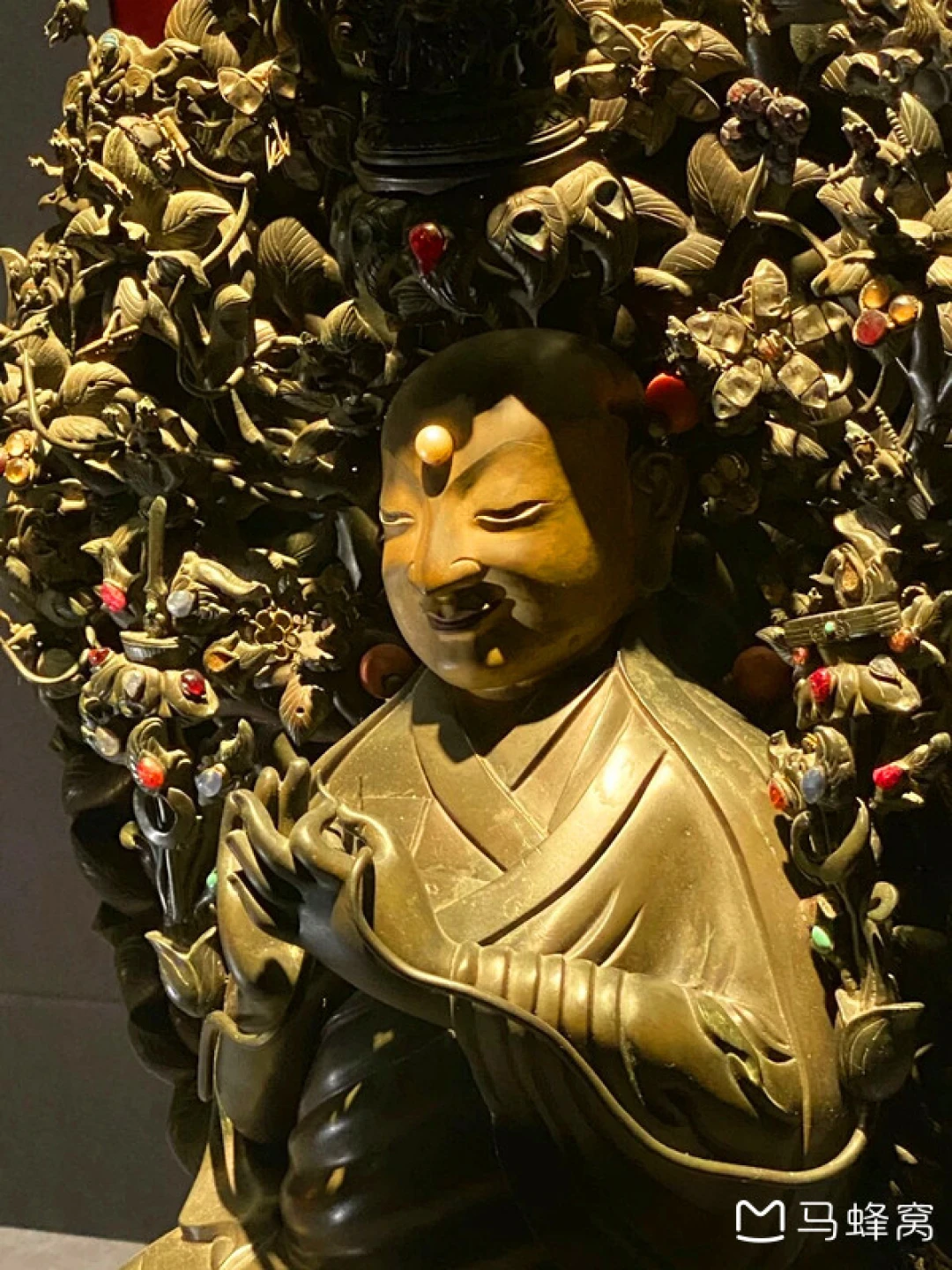
Meta Description: Explore the historic 2019-2020 exhibition at the Palace Museum, where Tibetan Buddhist art from Tashilhunpo Monastery met imperial grandeur. Discover thangkas, statues, and the cultural bond between Tibet and Beijing. Free exhibition details inside.
Introduction: A Rendezvous of Tibetan Art and Imperial Majesty
"When your wisdom has fermented into wine, you can still drown your sorrows." This lyric became my strange premonition for an exhibition that would bridge two worlds. On November 30, 2019, I made a promise to myself: I must enter the Forbidden City to experience a rendezvous between Tibetan art and imperial grandeur. The protagonist of this encounter was "Sumati Phuntsog" (须弥福寿) — a name that already carries stories and destiny within it.
"Sumati" comes from Mount Sumeru, the cosmic mountain in Buddhist cosmology, while "Phuntsog" means blessings and longevity. When combined, "Sumati Phuntsog" becomes the Tibetan translation of "Tashilhunpo Monastery" — a name that evokes the wish for boundless blessings and longevity, like the auspicious Mount Sumeru itself. This exhibition brought the artistic treasures of Tashilhunpo Monastery within the red walls of the Forbidden City, creating a cultural dialogue that spanned millennia.
Exhibition Overview: A Free Visual Feast at the Meridian Gate

Key Details for Visitors
- Dates: December 10, 2019 – February 29, 2020 (closed from January 25, 2020 due to the pandemic, and has not reopened since)
- Location: The Meridian Gate (午门) main hall and the East and West Yanchi Lou (燕翅楼) galleries, Palace Museum
- Admission: Free! Simply purchase a Palace Museum ticket (40 RMB/person; discounted e-tickets available on Mafengwo) and enter with your ID card.
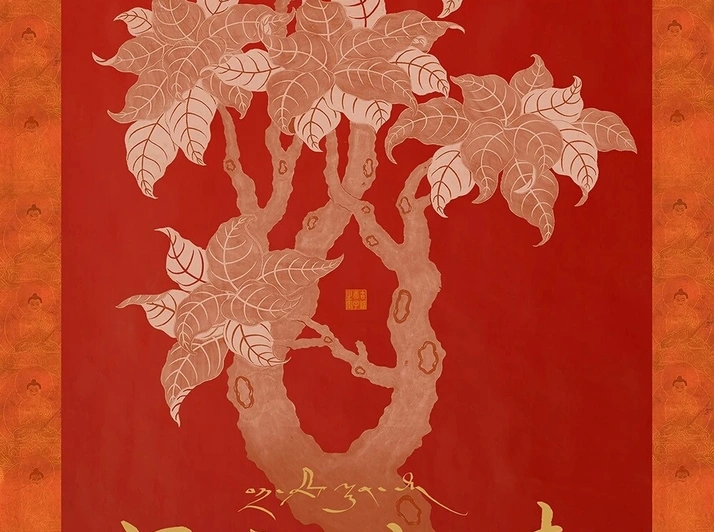
The exhibits mainly consisted of statues and thangkas. As an ordinary visitor, I tried to avoid complex religious terminology, offering you the most direct perspective into this spiritual feast. Special thanks to teachers Mao Mao (毛毛) and Zhao Yao (照耀) for their generous sharing. All photos (unless otherwise noted) were taken by the author on December 22 and 25, 2019.
[Link: How to Visit the Palace Museum on a Budget]
From Sumati Phuntsog to the Forbidden City: A Cultural Bond Spanning a Millennium
Today, the familiar titles "Panchen Lama" and "Dalai Lama" both trace back to the original disciples of Tsongkhapa, founder of the Gelug school of Tibetan Buddhism (whose titles were later posthumously recognized). Tashilhunpo Monastery served as the traditional seat of the Panchen Lamas — equivalent to the Potala Palace for the Dalai Lamas. Within Tashilhunpo, the Panchen Lama wielded immense religious and political authority.
Interestingly, each religious-political center had its own "imperial workshop": the Qing court had the "Imperial Household Department's Workshop" (内务府造办处), Tashilhunpo had the "Tashilhunpo Artisan Workshop" (扎什吉彩作坊), and the Potala Palace had the "Snow White Workshop" (雪堆白). Both of the latter two showed a strong tendency toward "archaism" — imitating earlier styles. At that time, the four major religious-political leaders (the Panchen Erdeni of Tsang, the Dalai Lama of Ü, the Changkya Khutukhtu of Inner Mongolia and Qinghai, and the Jebtsundamba Khutukhtu of Outer Mongolia) each managed their own domains, yet all coincidentally paid homage to earlier works. This "homage" was particularly evident in statue-making: on a single piece, you could find traces of older styles alongside new elements from the Tashilhunpo school, yet tracing back to a pure source was impossible — it was, frankly, imitation.
[Link: The History of Tibetan Buddhist Art in China]
The Origin of the Mian Tang Painting School: A Neglected Mural
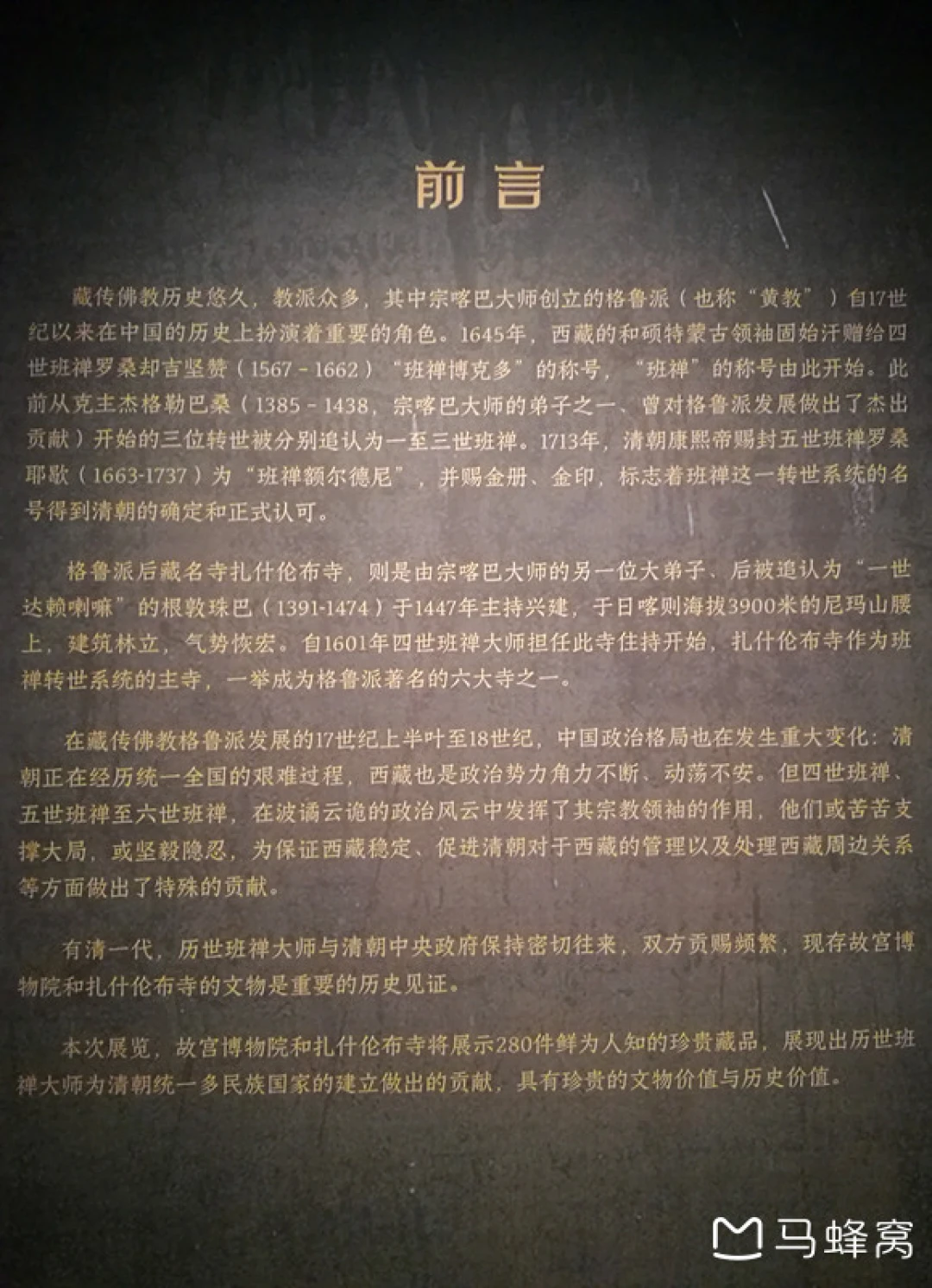
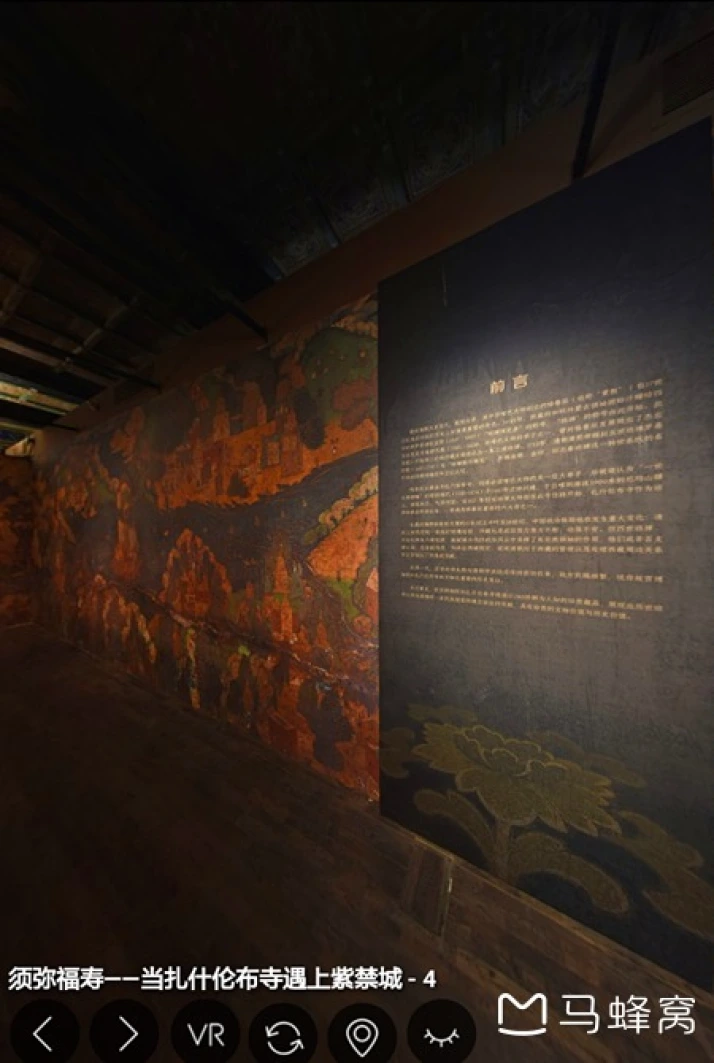
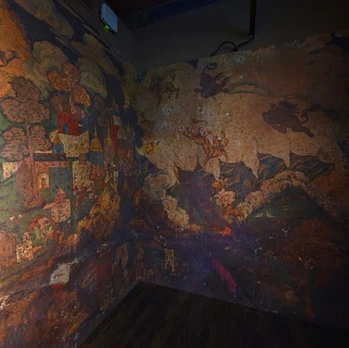
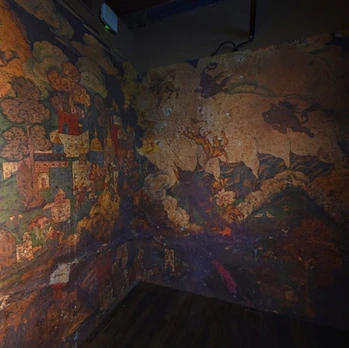
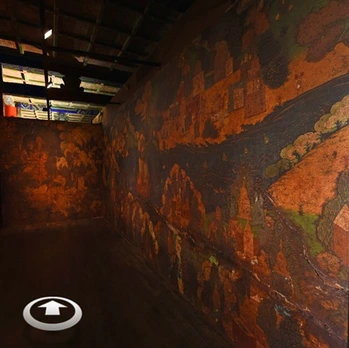
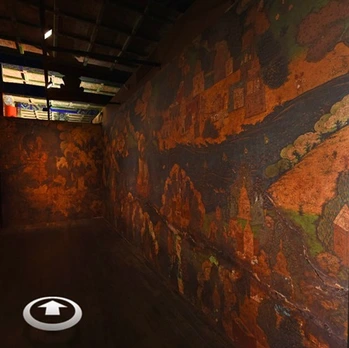
Entering the exhibition hall, most people crowded around the central display cases, completely ignoring the mural on the wall — myself included. On my first visit, I headed straight for the exhibits; only on my second visit did I slow down and carefully examine this massive work depicting the origins of the Mian Tang painting school (the image below is a VR panoramic screenshot).
This mural, reportedly a standard fixture at Tashilhunpo Monastery, was represented in the exhibition by a high-resolution scanned print. It tells us that before the 15th century, thangkas and murals were heavily influenced by Nepalese style, with a predominantly red color palette — at first glance, red was the hallmark of Nepalese influence.
The Mian Tang school emerged in the 15th–16th centuries, absorbing a great deal of Han Chinese painting techniques, especially blue-green landscape painting (青绿山水). Thus, we see the unique "textured brushwork" (皴法) characteristic of Chinese painting — lines depicting rocks, peaks, and trees. The trees were painted somewhat like tropical vegetation, not quite in the Central Plains style. But it was precisely this blue-green landscape, with its rocks, brushwork, and slightly Chinese-style trees, that made the Mian Tang style stand out.
The depiction of clouds was also a typical Mian Tang characteristic. This technique (including the painting of leaves) was borrowed from Han Chinese painting by both the Mian Tang and Karma Gadri schools. Interestingly, the figures in the mural have an exotic, non-Han Chinese appearance — because the early origins of thangka art include not only India but also Persian miniature painting, which had a profound influence on thangka development.
[Link: Understanding Thangka Painting Techniques]
Artistic Codes in Thangkas: From Subhuti to the Moon King
Subhuti: Asymmetric Elegance
- Date: Qing Dynasty, Qianlong 35th year (1770)
- Dimensions: 70 cm high × 24 cm wide
- Production: Tashilhunpo Artisan Workshop
- Collection: Palace Museum
A thangka is essentially a Tibetan scroll painting. The colors of this piece are closely tied to the Mian Tang school, but its style is not obvious. Mian Tang thangkas typically emphasize symmetrical composition, but this one features an asymmetrical layout with a sense of perspective — things closer are larger, things farther are smaller — completely different from Mian Tang's "center-dominated, grid-like" composition. The main deity occupies a large portion of the painting, with a transparent halo — this is an advanced technique. The water flows in an "S" shape, guiding the eye into depth, with the Buddha figures gradually shrinking — a common手法 of the Karma Gadri school. It's as if a Buddha statue were placed within a Chinese blue-green landscape painting. The floral painting is influenced by Han Chinese techniques, specifically the "graded wash" (分染) method of meticulous painting (工笔画), where colors transition from light to dark. The expressiveness of the rocks and mountains is superior in Karma Gadri compared to Mian Tang. Some say its founder was actually a Han Chinese painter — this speculation is not groundless.
The Second Panchen Lama: The Pinnacle of Black Thangka
- Date: Qing Dynasty, after Qianlong 45th year (1780)
- Dimensions: Outer frame 139 cm high × 91 cm wide; painting 83 cm high × 55 cm wide
- Production: Qing Imperial Workshop
- Collection: Palace Museum
This black thangka (黑唐卡, or "black tangka") is a top-tier category of thangka, not something ordinary painters could handle, and it's a quintessential imperial black thangka. Imperial court pieces emphasize neatness. The lines are relatively thick, no longer resembling the fine lines of meticulous painting — because using a brush with gold powder (沥金) didn't work well, so it was more like using a short brush. Even so, this painting is extraordinarily detailed, rare even among black thangkas. Black thangkas are already uncommon; they lack the piled-up colors of other thangkas, resembling more of a line-drawing in meticulous style, and they are extremely neat, especially the Tibetan script in a regular script style (馆阁体/台阁体), which looks almost printed. The composition is asymmetrical, continuing the Karma Gadri style.
It is divided into three layers from top to bottom: at the top are the lamas (teachers, guides), showing reverence; in the middle is the main deity, occupying the largest space; at the bottom are the protectors. Most thangkas follow this layout.
The Moon King: The Prestige of Tibetan Mounting
- Date: Qing Dynasty, Qianlong 38th–39th year (1773–1774)
- Production: Tashilhunpo Artisan Workshop
- Collection: Palace Museum

This piece reveals the differences in thangka mounting: the Tibetan mounting style is distinct from the Han Chinese style. The brocade used in Tibetan mounting is often more vibrant and uses thicker fabrics, while Han mounting tends to be more subdued. The Moon King thangka showcases the prestige of Tibetan mounting, with its rich colors and intricate patterns that reflect the artistic traditions of Tashilhunpo Monastery.
[Link: The Art of Tibetan Thangka Mounting]
FAQ: Your Questions About the Tashilhunpo Monastery Exhibition
1. Is the exhibition still open?
 No. The exhibition ran from December 10, 2019, to February 29, 2020, but was closed early on January 25, 2020, due to the COVID-19 pandemic. It has not reopened since. However, the Palace Museum continues to host rotating exhibitions of Tibetan art.
2. What were the main highlights of the exhibition?
 The exhibition featured over 200 artifacts, including thangkas, statues, ritual objects, and textiles from Tashilhunpo Monastery and the Qing imperial collection. Key highlights included the Subhuti thangka, the black thangka of the Second Panchen Lama, and the Moon King thangka with its distinctive Tibetan mounting.
3. How can I see similar Tibetan art in Beijing?
The Palace Museum's permanent collection includes Tibetan Buddhist art in the Hall of Union and Peace (交泰殿) and the Hall of Mental Cultivation (养心殿). Additionally, the Tibetan Buddhist Art Museum at the Yonghe Temple (Lama Temple) offers a rich collection.
4. What is the significance of the name "Sumati Phuntsog"?
 "Sumati Phuntsog" is the Tibetan translation of "Tashilhunpo Monastery." "Sumati" comes from Mount Sumeru (the cosmic mountain in Buddhism), and "Phuntsog" means blessings and longevity. Together, they evoke the wish for boundless blessings and longevity.
5. What is the difference between Mian Tang and Karma Gadri painting styles?
Mian Tang emphasizes symmetrical composition and blue-green landscapes, while Karma Gadri uses asymmetrical layouts with perspective and more expressive rock and mountain painting. Karma Gadri was influenced by Han Chinese painting techniques, and some scholars believe its founder was a Han Chinese painter.
Conclusion: A Journey Across Time and Space
The "Sumati Phuntsog" exhibition was more than a display of artifacts — it was a bridge between two worlds: the spiritual heart of Tibet and the imperial majesty of the Forbidden City. From the neglected mural of the Mian Tang school to the exquisite black thangka of the Second Panchen Lama, each piece told a story of cultural exchange, artistic innovation, and shared history.
Although the exhibition has closed, its legacy lives on. The Palace Museum continues to preserve and showcase these treasures, reminding us that art transcends time and space. Whether you're a seasoned art lover or a curious traveler, the story of Tashilhunpo Monastery and the Forbidden City is a testament to the enduring power of cultural dialogue.
Ready to explore more? Plan your visit to the Palace Museum today and discover the hidden gems of Tibetan Buddhist art. [Link: Book Your Palace Museum Tickets Now]
All photos (unless otherwise noted) were taken by the author on December 22 and 25, 2019. Special thanks to teachers Mao Mao (毛毛) and Zhao Yao (照耀) for their generous sharing.
Primary Keyword: Tashilhunpo Monastery exhibition Forbidden City
Long-tail Keywords: Sumati Phuntsog exhibition, Tibetan thangka art Palace Museum, Mian Tang painting school, black thangka Qing Dynasty, Tibetan Buddhist art Beijing, Tashilhunpo Monastery history, Panchen Lama art exhibition
You should also read:
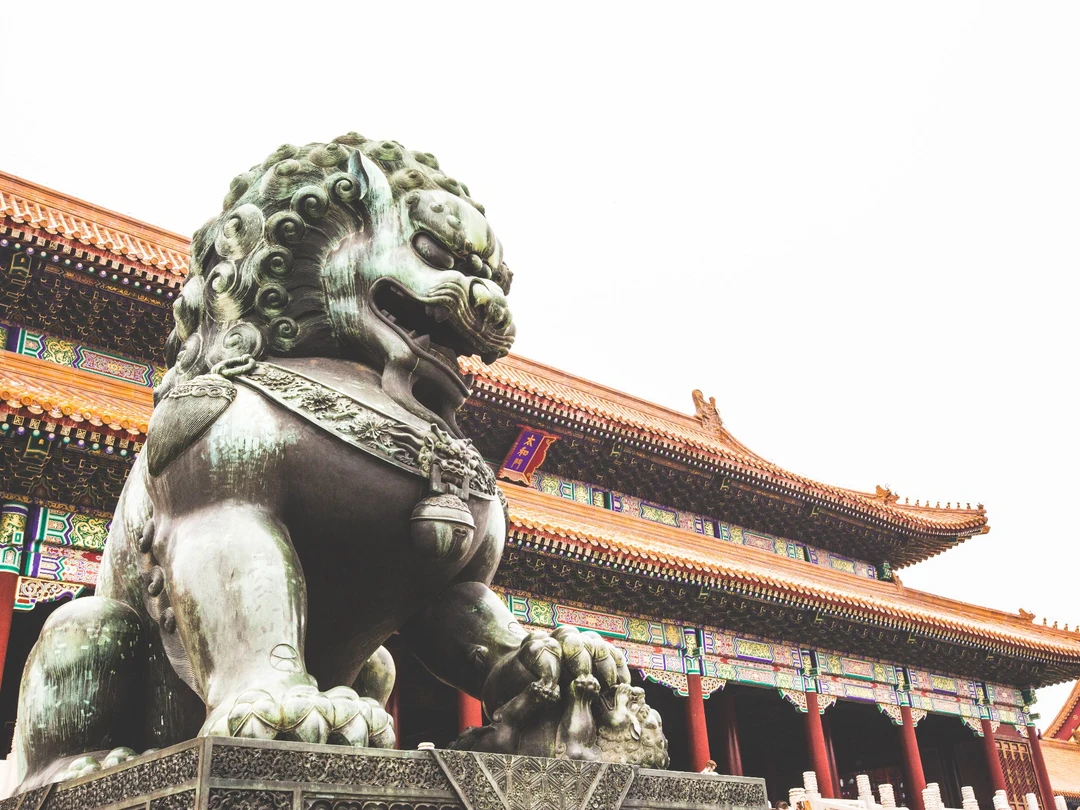
First Visit to Beijing: Living in a Century-Old Courtyard, Being the Forbidden City's Neighbor
Meta Description: Experience Beijing like a local with this first-timer's guide. Stay in a century-old siheyuan near the Forbidden City, explore hutongs, climb the Great Wall, and avoid common tourist pitfalls. Your ultimate Beijing itinerary awaits. I've always believed that the best kind of travel…
Continue reading...
Beiping: A City Where the Aroma of Street Food Meets the Poetry of the Distant Horizon
Here is the SEO-optimized, rewritten article based on your source material. It is structured for search engine visibility while maintaining the poetic, travelogue style of the original. SEO Title: Beiping Travel Guide: Street Food Aroma, Hutong Culture & The Poetry of Beijing’s Horizon Meta Description:…
Continue reading...
Lost in Beijing for Seven Days: A Solo National Day Journey Through the Capital
Meta Description: Discover how to survive—and thrive—during China's Golden Week in our SEO-optimized Beijing travel guide. From hidden hutongs to imperial palaces, this 7-day solo itinerary reveals crowd-avoidance secrets, budget tips, and must-visit attractions. Some say traveling during National Day is asking for trouble. But…
Continue reading...